

Last week, as is usual for the Mustians, we watched a documentary about nature to close out the Lord’s Day. This particular episode was about life on and around Antartica. In one video shot of the surrounding ocean, a whale was seen just barely surfacing above the water. To this Jàel exclaimed, “What was that?!?” To this question I responded, in a measure of sarcasm, “A sea monster.” Of course I knew my sharp five-year-old wasn’t going to buy it…”Oh Daddy, you’re being ridiculous!” And she was right…or was she?
Not too long ago we would have been left to speculate what that monstrously large animal was. Underwater cameras are very recent in human history. Imagine being on a boat and seeing a whale’s fin just barely surface; what would we think of it? It is no surprise, that countless sea-monster legends were passed down from one generation of sailers to the next.

Photo by Thomas Lipke on Unsplash
We only see part of the whole; thus in a measure of ignorance we come up with an answer that is less than truly informed.
Read Quickly
Disclaimer: This post does not intend to convey that the only good way or the best way to read the Bible is to read it quickly. Below is simply shown why it is good to do so on occasion.
The child of God will benefit from a clearer understanding of the layout of the Word of God from Genesis to Revelation. When we only focus on one section or one book we slowly begin to see the Word of God as the sailer sees the whale. If we do not have the whole in view we make false assumptions about the parts.
As you take this step and hammer through your Bible in less than a year (4 chapters a day), consider the following:
1) Find a good outline of each book
You can go to a study Bible or on google to find an outline created by a trusted pastor. The outline provided in a study Bible (or online) can help you see the journey through the book, and so align your reading with each book’s flow. The chapter breaks do not always give the best start and stop places. However, an outline from a study Bible can easily get you on track. So as you read your 3 or 4 or 5 chapters there is a sense of direction, and for what it’s worth, that trusted teacher (MacArthur, Mohler, Sproul, Jeremiah) can assist you in seeing the bigger picture…after all that is what we are pursuing in the quick read from Genesis to Revelation.
2) Get the big picture of each book and the Book
Let’s revisit this idea a little more. To understand the small parts it is necessary to have a familiarity with the whole. We talked about the whale above. Now let’s consider a city. If I drop you off on a random block of a city anywhere in the world without a map or smart phone, you will have trouble navigating or leaving the city. If you do not know the city’s general layout you cannot make sense of the small parts such as its blocks and buildings. We better understand the small parts in light of the bigger picture. However, as you stand on that city block, lost and uncertain, a city clerk hands you a map. Once you have the large layout of the city before your eyes you understand how your current block fits into it. So also we understand the Bible’s stories and songs, proverbs and promises more truly when we see them as pieces of a bigger puzzle.

3) Be better equipped for future Bible study
I am currently reading Ezekiel for my personal reading. I just began to read about his vision where Ezekiel sees the future temple (Eze. 40-48). I have been asked many times what I understand Ezekiel to be communicating to us in that vision. I have always answered: “I am not sure.” My biggest hang up to understanding is not only the complexity of the last nine chapters, but also that I have not given enough time to reading the book of Ezekiel as a whole. Before I put all focus on the particular of Ezekiel’s vision at the end, I need to give mind to the whole 48 chapters. Then I can see the last nine chapters more appropriately.
By reading the Bible quickly now-and-again you set yourself up to be better able to study specific verses and stories, or to discuss them in an informed fashion. When a brother and sister in Christ comes to you for help in understanding a verse he or she is reading, you will be more readily able to assist them when you have a familiarity with the big picture.
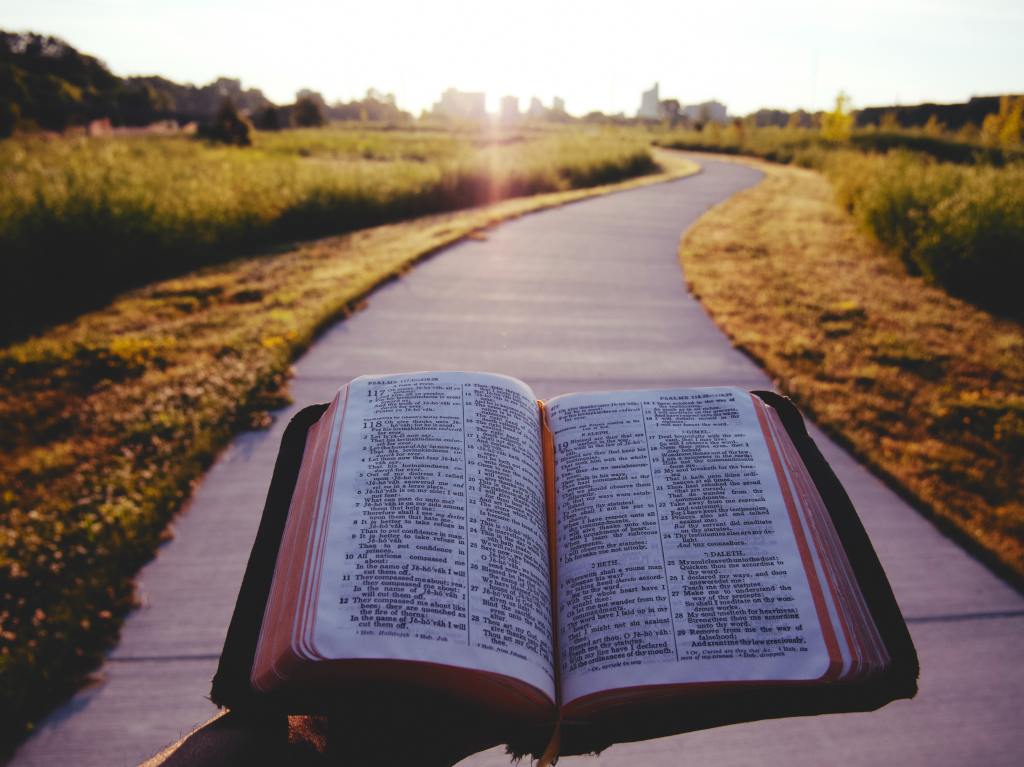
Photo by Aaron Burden on Unsplash
Closing Thoughts
Although we cannot know God’s word fully we can know it truly. This comes to us by the Holy Spirit, yet we are not inactive in this. We go to the Word with the prayer of David: “Open my eyes that I may see wondrous things from your law…” By both slower and faster paces of reading we grow our familiarity with this grand narrative. Upon the route of quick reading we guard ourselves from partial perspectives that turn into “whale stories”, yet we also set ourselves up for clearer understanding of the particular chapters and verses.
May the Lord bless your reading this year. May his abundant grace fill your heart as you read of it in the Word.


This is great! I’ll be applying this approach to my reading from now on!
Thank you Son!
Mamaw
LikeLike
All the intricate details of the Scriptures are woven in the rich tapestry of God’s glorious redemptive plan. Reading these revelations as a whole does help us see the richness of the complete work, not just where they intersect.
LikeLiked by 1 person
Yes it does.
LikeLike
Interesting thoughts. I may try this kind of reading this year. Thank you for sharing.
LikeLike