

“Why can’t followers of Jesus just get along?”
“I do not believe in denominational titles…there is only one church?”
“If the protestant reformation had not happened there would still be one united church.”
“I am non-denominational…Christians just need to love each other and not get caught up in doctrine.”
Sound familiar??
True enough, we are a mess…Baptists…Presbyterians…Reformed…Lutherans…Anglicans…Methodists. I would personally say that the worst of the bunch are the baptists…and I say that as a born and bread baptist who has spent 2/3rds of his life with the Southern Baptist Convention and the other 1/3rd with the North American Baptists. I say the baptists are the messiest because I am the most familiar with this denomination and so I am far more acquainted with its scars and warts…yet I love the baptists. I’ll say more to this in a moment.
If we are all messy…short-sighted…unbalanced, why not all of get together and be one church, one group, one name?
Three Thoughts
Denominations as we know them begin to develop shortly after the Protestant Reformation: Anglican, Presbyterian, Reformed, Anabaptist, and Lutheran…later on the Methodists.
However, it would be inaccurate to think that the church was at harmony and united until the 1500’s and then became divided. For with in the Roman Catholic church there had been divisions as well. In the few hundred year leading up to the explosive work of Luther, and then Calvin, there were strong and various opinions circulating through the church…why? Various views and opinions existed in the church, as they do today, because of our limited minds. The idea of reformation for the Catholic church had been in the air for decades even before Luther was born.
1. Denominations: God’s Fault or Human Faults?
I mention this reason for denominations first because it is most common answer given. One might say, and rightfully so, “Our minds can’t fully grasp the truth of the Bible, and in our personal misunderstanding we don’t always see eye-to-eye.” You see this even in your home church I’m sure. There are very weighty and important truths of scripture that your church family affirms but then there are other teachings in the Bible, parts that aren’t as clear, that you disagree on. Yet, this does not necessarily form a division in your congregation. That is what we might call unity amid diversity which is known in a word: harmony.
Whether the points of difference are formally and systematically put forward (post reformation era of denominations) or those differences exist within one group (pre reformation era) they are due to our frailty. We do have denominations now because the larger the church has grown and the longer it is around, the more opportunities for misunderstanding.
2. How Different are the Denominations?
Earlier when I listed off the various protestant denominations you might have raised an eyebrow as you saw names that you might associate with beliefs that are not just different but heretical. Let me clarify that list here and now. I mentioned a wide list to emphasize the variations that there are, yet I do not mean to commend churches, church associations, or church conferences that have denied the core and fundamental doctrines of our faith (such doctrines I will mention in a moment).
When we consider denominations that have upheld the Bible as its authority and submitted to its teaching we still find that denominations are not as completely separate as we might think. Most denominations have more in common than not: namely the primary issues.
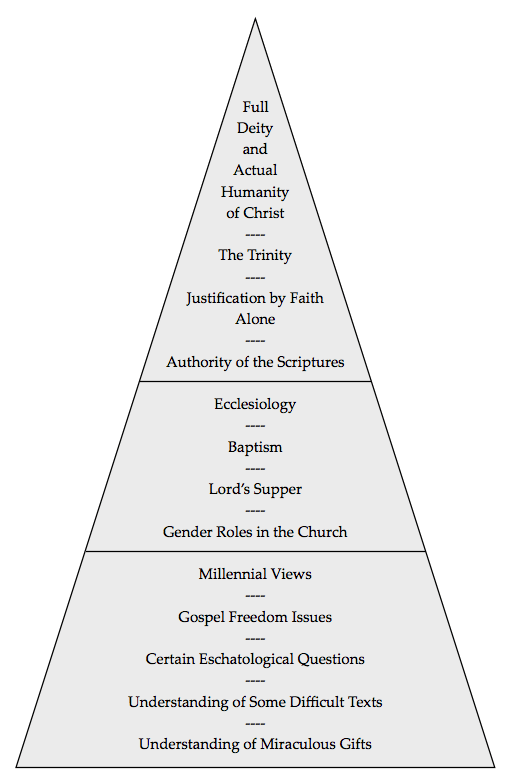
This graph is from Gavin Ortalnd’s book Finding the Right Hills to Die On (a great yet concise book on how to think about difference between Christian groups). The statements in the top level of this chart are where we find the truths that bind all orthodox denominations and churches. Remember, I am not talking about churches who are blatantly opposing and overturning God’s design of gender and marriage…and the like. We can look to the Baptists…Presbyterians…Reformed…Lutherans…Anglicans…Methodists and find brethren who love Jesus by affirming these truths.
So find (above) one of the named denominations that you most closely align with. Now look around at the other five and realize you don’t necessarily have great difference with the others.
“Sean, if its so simple then why don’t we have one church building…one elder board…one congregation?”
Like I mentioned above…our faulty minds still keep us from perfect understanding…hence one child of God holding one conviction and another child of God holding another…particularly in the middle section of the chart above…that is the answer as to why we still have…and probably will always have “denominations”.
True enough that orthodox congregations find unity in the fundamentals of the faith as represented, in part, on the graph’s top level, yet it is permissible to vary on the second level. Within biblical Christianity there is room for disagreement in these areas of (1) how churches should be run, (2) participants of Baptism/Lord’s Supper, etc…yet it is impractical at best and impossible at worst to function well as one local church.
Yet, there is benefit from these strong differences.
3. Are Denominational Differences Helpful?
Flowing from the words of Paul that “there must be factions among you in order that those who are genuine among you may be recognized” (1 Cor. 11:19) flows a principle that we can benefit from. This principle is not to form a sectarian mindset between denominations but instead give perspective which comes to us from Proverbs 27:17, “Iron sharpens iron, and one man sharpens another.” Out of this we may safely conclude that the corpus of the orthodox denominations will serve the Kingdom of God by keeping one another sharp. So long as we keep healthy communication up between the brethren across denominational lines we will not be at the risk of having a denominational echo chamber.
As an example, one can express his beliefs about baptism freely and loosely among members of his denomination, yet when he has coffee with a brother from another group he may be challenged. He will be challenged to accurately and thoughtfully convey his perspective, while at the same time he will be pressed by his brother who holds a differing view. The critical approach of the opposing view will hopefully lead the conversation to revisiting the scriptures. This is a good thing: our traditions being purified by the Word. Therefore, various groups or denominations with differing perspectives on secondary issues can be a great asset to the church as a whole (around the world and across time).
Two Final Thoughts
First, on a positive note we find that a reason for denominations is a backbone of conviction. The believer studies the scriptures and reaches a conviction about truth and so wishes to honor God in it. This should be seen a sign of Christian maturity. However, it goes badly when the believer confuses his biblically formed opinion for absolute truth. Let the image below illustrate this:
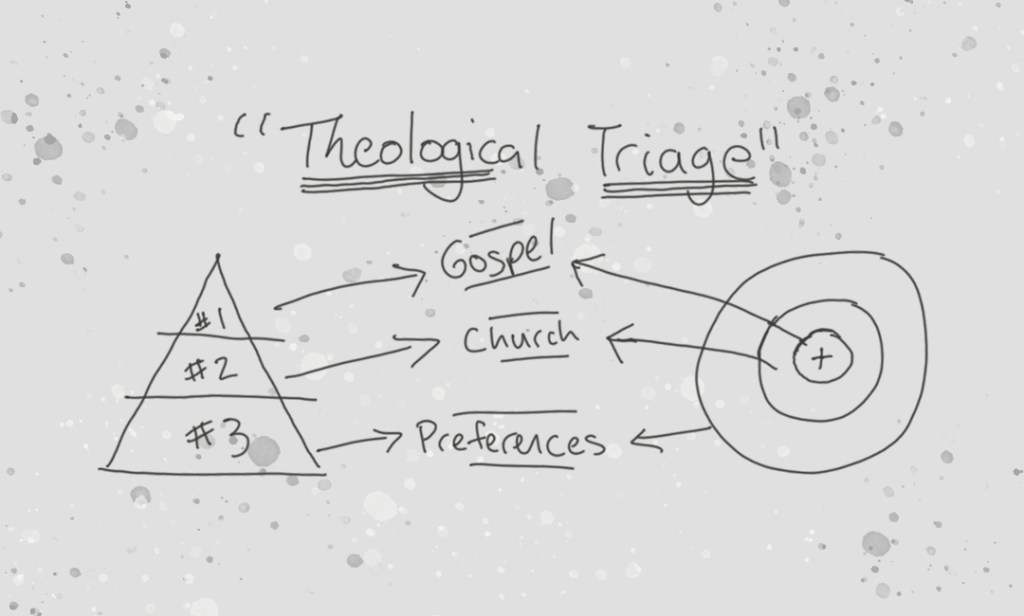
When we are able to distinguish our convictions appropriately as represented in the graph we can live well with the brother from the church down the street…as well as our fellow church members.
Above I mentioned my love of my fellow baptists despite our messiness. Whether we are talking about differences of denomination or differences of brothers of the same church family, we must discern what is a conviction of a personal “preference”, a “church” level conviction, and what are true “gospel” issues. If we keep that in mind we may certainly have unity amid diversity, that is harmony. Be a saint of conviction and compassion.
Finally, I do hear those who wish for peace and less “division” among the churches of Christ. I wish for that to. However, I do not think we will see that until the New Heavens and New Earth are brought about by God in which righteousness dwells. And that thought should give us hope for the future.
Maybe a reason God does not allow us to experience the perfect unity we wish for in this life is because he wants us to continue longing for our heavenly home. What if God has given us a strong desire for the unity of all God’s children because he does in fact intend for us to experience that joy?? just not yet. Maybe it is a reminder to us that the age of this world in which we live is not our home. We long for unity…striving for it…hoping for it…not seeing it now but one day walking in it in a way beyond our wildest dreams.
In a Bible study several years ago, myself and another brother in Christ openly expressed, yet respectfully, our different views on the return of Christ. I texted him afterwards and said, “I look forward to praising our King together in the New Creation where there will not even be a hint of division.”
May God give each of his children that desire and hope.
Further Reading:
An Open Letter to Those Who Divide over Doctrine by Gavin Ortland
4 Ways to Practice Theological Humility by Gavin Ortland
 The Reforming Raker
Excellent! Keep up the good work! So insightful.
Love u Mamaw
On Sat, Apr 2, 2022 at 10:06 AM The Reforming Raker wrote:
> Pastor_M. posted: ” “Why can’t followers of Jesus just get along?” “I do > not believe in denominational titles…there is only one church?” “If the > protestant reformation had not happened there would still be one united > church.” “I am non-denominational…Christians” >
LikeLike