

For the past few months at Central Baptist we have looked at God’s plan and work for the salvation of His people.
Specifically we looked at what are called The Five Solas: Salvation is
- by grace ALONE
- through faith ALONE
- in Christ ALONE
- according to scripture ALONE
- unto God’s glory ALONE.
We went through staple passages on grace (Eph. 2:1-10), faith (Romans 4:1-3), Christ’s work (Heb. 7:23-28), scripture (2 Tim. 3:16-17). However, our final passage was a little unconventional. Normally a sermon on God’s glory in this context would come from Romans 11:33-36 or chunks of Ephesians 1 or even the praise in heaven as described in Revelation 4-5. However, that is not where we landed.
Now before I mention the passage let me say that I did not have some special insight that no one else has ever seen. No, not at all. As a matter of fact the chapter I preached was recommended to me by various books from John Piper, Ross Blackburn, James M. Hamilton Jr., and John’s book of Revelation (I’ll explain how Revelation ties in).
That text was Exodus 15, namely Moses’ Song of praise to God for His judgement on Egypt and redemption of
Israel.
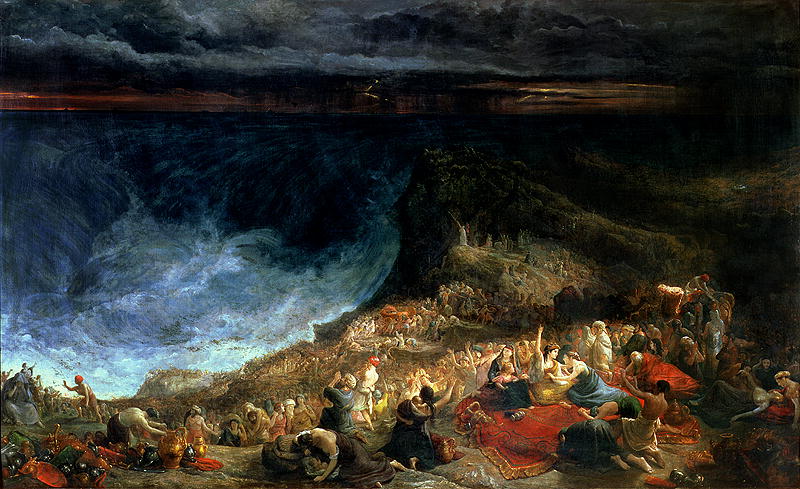
In some ways this was an unexpected turn in the series, but in other ways it was expected. Here is why.
The Five Solas in Genesis
What I came see over the two months of preaching on these doctrines is that they root back to Genesis. Below I want you to see how the Gospel is presented to us in seed form within the boundaries of Genesis, and then it grows and blossoms as the scriptures unfold.
Grace and Faith
If you have read the New Testament only a handful of times you will know that Abraham is the most frequently referenced Old Testament name, second only to Moses. The New Testament authors speak much of him as an example of faith and of seeing God’s grace at work.
In Romans 4 and Galatians 3 Paul builds his teaching around the stories of Abraham found in Genesis 12:1-3 & 15:1-20. In those parts of Genesis we find God’s gracious plan and promise:
“Now the LORD said to Abram, ‘Go from your country and your kindred and your father’s house to the land that I will show you. And I will make of you a great nation, and I will bless you and make your name great, so that you will be a blessing. I will bless those who bless you, and him who dishonors you I will curse, and in you all the families of the earth shall be blessed’.”
Genesis 12:1-3
And he brought him outside and said, “Look toward heaven, and number the stars, if you are able to number them.” Then he said to him, “So shall your offspring be.” And he believed the LORD, and he counted it to him unto righteousness……Then the LORD said to Abram, “Know for certain that your offspring will be sojourners in a land that is not theirs and will be servants there, and they will be afflicted for four hundred years. But I will bring judgment on the nation that they serve, and afterward they shall come out with great possessions……On that day the LORD made a covenant with Abram, saying, “To your offspring I give this land, from the river of Egypt to the great river, the river Euphrates…”
Genesis 15:5-6, 13-14, 18-19

Amid these words of covenant promise is seen the divine blessing of faith: Abraham believed God and it was counted to him unto righteousness. From this phrase Paul would launch into his best teaching on justification by faith alone in Romans 4 and Galatians 3. Paul shows us how the story of Abraham teaches the people of God that no effort of our own earns God’s grace.
To the Romans he explains that the Christian has absolutely no boast to make. In other words, if you believe you can say: I am going to heaven because I _____________________? You are wrong. We have nothing to boast about (Rom. 3:27-4:3).
And to the Galatians he explains that no amount of religious activity or practice, even the most significant, can earn or maintain God’s gracious love (Gal. 3&4). That is why we believe that we are loved unconditionally.
So then, what we know from Ephesians 2:8-9 that we are saved by grace through faith, has been a part of biblical teaching from the very earliest chapters. We, the people of God in the Old and New Testaments have been saved by the grace of God through the means of faith.
Christ
How can God be gracious to rebellious sinners like us and so kindly grant us faith? There must in some way be atonement for God to remain righteous and yet the one who declares sinners to be righteous (Rom. 3:26). A priest must offer a sacrifice to appease the wrath of God.
Paul gives us the answer in Hebrews 2:17-3:2; 4:14-5:10; 6:17-10:25. Now, amid all of these wonderful verses is a connection back to Genesis. In Hebrews 7 Paul reminds us of another great priest from Genesis 14, Melchizedek. Paul uses this Old Testament character to explain the person and work of Jesus as the Great High Priest.
Therefore, we begin to learn of our Heavenly Priest by reading Genesis 14:18-20 (as well as Psalm 110:4). This is a blessed pursuit in which we better appreciate our salvation. For when we say, as above, that we are saved by Christ ALONE, we are speaking of his priestly sacrifice at the cross. So one way we begin to understand and take comfort in this is to read of Abraham’s meeting with that priest of old. From there we can then go into Hebrews 7 and be taught by the apostle of the specific significance of Melchizedek.
So, it is by our Great High Priest that we have been saved by grace through faith…but how do we know this?
Scripture

According to scripture, and scripture ALONE do we learn of God’s gracious kindness to us as worked out at the cross of Christ. This is our only authority regarding what we believe and how we act in light of the truths we confess. Once again we see the role of God’s word as our authority from the very beginning.
What did God say to Adam and Eve:
“…the LORD God commanded the man, saying, ‘You may surely eat of every tree of the garden, but of the tree of the knowledge of good and evil you shall not eat, for in the day that you eat of it you shall surely die.”
Genesis 2:16-17
What happened when they set aside the word of God:
“So when the woman saw that the tree was good for food, and that it was a delight to the eyes, and that the tree was to be desired to make one wise, she took of its fruit and ate, and she also gave some to her husband who was with her, and he ate. Then the eyes of both were opened, and they knew that they were naked. And they sewed fig leaves together and made themselves loincloths.”
Genesis 3:6-7
We learn of our need to hold and keep the spoken word of God as recorded in the Bible by seeing what happens when His word is neglected and rejected. Just as God spoke and there was life (Gen. 1), so we must understand that God’s word is life giving to His people. Therefore we must abide in it with gratitude and gladness, humility and happiness.
God’s word and commands are not kill joys but guides leading us to the fullness of life. God is not only the creator of all, but the designer. Therefore, He knows what is best. To embrace his word and so trust His grace and His Son is to embrace an abundant life, that is: life as God designed.
God has spoken and made both His person and work known to us, yet He also makes known his goal, but that we will look at next time.
 The Reforming Raker
Amen! Really enjoyed this. Love you Mamaw
On Sat, Mar 5, 2022 at 1:14 PM The Reforming Raker wrote:
> Pastor_M. posted: ” For the past few months at Central Baptist we have > looked at God’s plan and work for the salvation of His people. Specifically > we looked at what are called The Five Solas: Salvation is by grace > ALONEthrough faith ALONE in Christ ALONEaccording to ” >
LikeLike