

Not too many people can say they have never misrepresented a person or an idea. We get misinformation from someone and pass it on. Or we read a news heading on Twitter. We misunderstand a persons statements…and the list goes on and on of how an idea or event can be misrepresented. This often happens in theology. It is especially noticeable when you have a topic like the Millennium where we find distinct schools of thought about the doctrine. We may begin to misrepresent another view on the topic. It is often unintentional and certainly not malicious. Many who argue against an opposing school of thought, yet put forward a straw-man, do it without realizing it, and at times with good intentions.
A “straw-man” is a false idea or representation of a teaching or opinion that is easy to disprove in order to try and make a point. Again I believe that in theology it is often done with no ill will.
I want to point out and clarify some common “stray-men” that arise against the Amillennial understanding of the Millennium.

Straw-man #1 – No Rapture
Amillennialism believes in the bodily return of Jesus for his people on earth. The most pointed and common text on this event is 1 Thessalonians 4:13-17. The event specifically spoken of in 4:17 in which we “will be caught up (raptured) together with them in the clouds to meet the Lord in the air…” is the point of difference. Amillennialists believe this rapture text to be teaching the one and only coming of Jesus to earth with a loud shout (no quiet rapture here) when we will “meet” the Lord. This word “meet” was used in ancient times to tell of the citizens of a city going out to meet their returning king and continue the journey with him into the city. Amillennialists believe that the rapture is our “meeting” the Lord on his way to earth, not a remaining in the air with the Lord for seven years of tribulation on earth.
In a nut shell we believe in a bodily return of Jesus.
Straw-man #2 – The Church Replaces Israel
No, not at all. I wish there was a short and simple explanation to what is believed by Amillennialists about the relationship of Israel and the Church. However, I can say that “Replacement Theology”, although often pinned on Amillennialism, is not taught in this school of thinking.
What at times is confused as “Replacement Theology” is what I at times nick-name “Inclusion Theology”. It may not be the best name but here is what is meant by it. Israel is not excluded from God’s promises and replacement, but instead are included into Jesus’ New Covenant people (i.e. Peter, John, Paul, James…etc). Paul speaks in Ephesians 2 of Jesus…

For he himself is our peace, who has made us both one and has broken down in his flesh the dividing wall of hostility…that he might create in himself one new man in place of the two, so making peace, and might reconcile us both to God in one body through the cross, thereby killing the hostility.
Ephesians 2:14-16
Now I’m sure in the minds of some that raises questions about the promises made to Israel… which leads to Straw-man #3…
Straw-man #3 – The Promises to Israel of Spiritually received in the Church
We can all affirm that God is faithful and never changes. Amillennialism may differ in some secondary issues regarding the end of time, yet it holds to the fundamentals of the faith. With that have been, I confess, some poor presentations by Amillennialists regarding the way in which God’s promises come to fruition. However, when one looks at the books and teachings of long standing, influential voices of Amillennialism one finds a strong affirmation of God fulfilling his promise of land, blessing, offspring, and a king. Where the Premillennialist says these things are given in the Millennial Kingdom, the Amillennialist says they occur in the New Creation (Isa. 65; Rev. 21-22). That’s the short answer. If you want more details check out the first seven paragraphs of this article by Sam Storms.
The promises are not spiritualized but do come into reality for the people of God by the Son of God. In the New Creation Jesus will reign on the earth in his glory, with blessing upon blessing for the people of God, in the land (the earth [Rom. 4:13]) God has promised. In this all of Israel who follow in the steps of Abraham in believing the promises of God will receive the promises made in Genesis 12, 15, 17 & 2 Samuel 7.
Straw-man #4 – Amillennialism must be dismissed because it is taught by the Roman Catholic Church
I have read countless articles and heard many teachers critique Amillennialism in this way. They start by noting that this view was not held by the first Christians after the Apostles died off, but came later through Augustine, and then popularized by the Roman Catholic Church. The problems are therefore that 1) It was not apostolic teaching but a man made doctrine; 2) Because the Roman Catholic Church embraces it, it must be rejected. To the first objection I point out that:
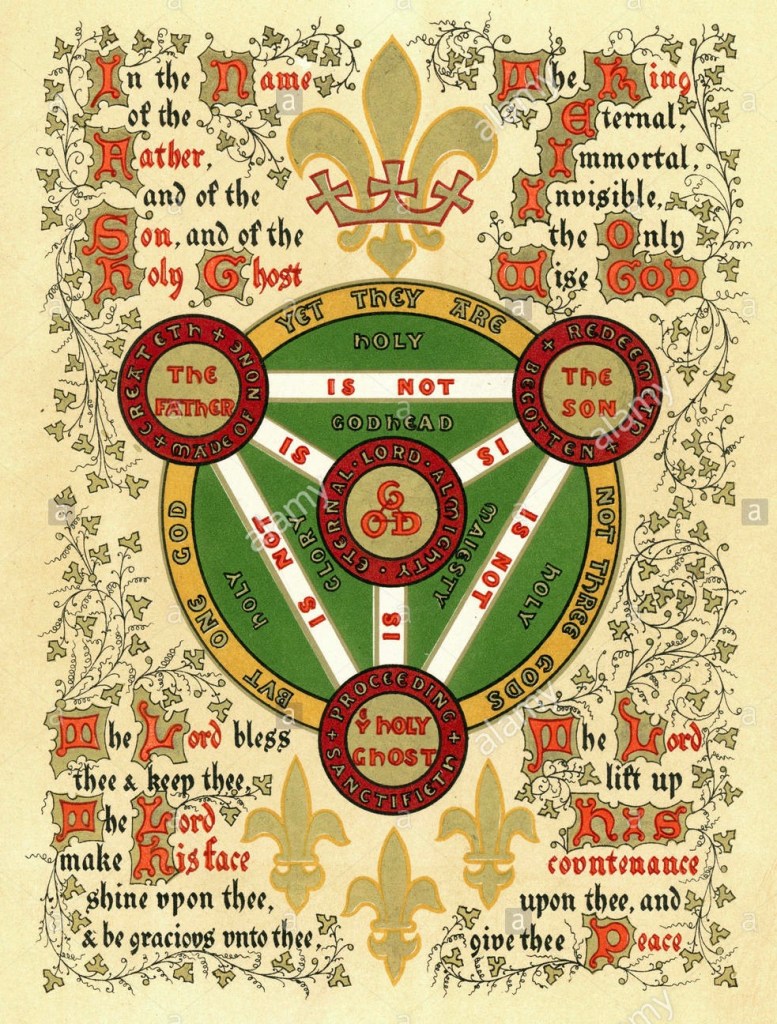
- Doctrine was fleshed out on many fronts over the course of the first few centuries of the church, and is still being worked out unto today. It is a big claim, one that would need to be proven, to say that a particular view on a doctrine did not arise until a particular time or year. This can be done with some views of doctrine, however what is more common is that at a particular time a doctrinal view is formally articulated or popularized. As an example it would be incorrect to say that the church did not believe in the Trinity until the 5th Century when the Athanasian Creed was written. What is true is that the church is seen in various writings to believe in the Trinity long before the 5th Century, however, it was most formally articulate sometime around the 5th Century in the Athanasian Creed. So it may well be true that Amillennialism was not popularized until e few centuries after Christ, but that does not nullify it.
- We also must realize that as the Church continues on earth our understanding of the truth develops as we learn from previous generations. If we want to hold the argument that Amillennialism and all other doctrines that arose in popularity centuries later should be rejected, then we have a big problem. The problem we encounter is the fact that the first few generations of Christians, there in the Roman empire, sometimes had some wonky views on the nature of Christ, redemption, etc. Which is understandable. They were trying to make sense of the gospel without always having the entire Bible for their use. Remember that not every Christian has always had access to a whole Bible in their native tongue. From that atmosphere some weird theories about God, salvation, the Holy Spirit, and much more arose. The first few generations of Christians were not pure in doctrine and super Christians untainted by philosophy or Judaism. Just because they had a certain view of the Millennium does not mean it was right.
To the second objection:
- True this is the eschatology of the Roman Catholic Church. However, are we to reject every thing they affirm…bye bye Trinity. Just because a false religion affirms a belief does not necessitate the teaching to be false. As the old saying goes, “Even a broken clock is right twice a day.” In short, it’s irrelevant to the conversation that Rome affirms it. The question is, to the one who adheres to this understanding: Does scripture affirm it? To the one who rejects this understanding: Does scripture deny it? Rome has no voice in the conversation.
Conclusion
I know this has not spoken to every concern or “straw-man” regarding Amillennialism, yet i hope what has been provided is helpful. If you have a specific question about or challenge to this view on the 1,000 year reign of Jesus please leave a comment below.
In all areas of biblical teaching, study, and disagreement let us make effort to understand what our brethren believe. Let us be cautious not to put words in their mouthes. I believe the more we talk about supposed differences with our brethren the more we will find that our common ground far outweighs our minor differences. We can only reach that fellowship through careful, honest, and charitable conversations with those who read passages differently than we do.
 The Reforming Raker
Keeps us thinking! Interesting thoughts!
Love you! Mamaw
On Sat, May 1, 2021 at 10:37 AM The Reforming Raker wrote:
> Pastor_M. posted: ” Not too many people can say they have never > misrepresented a person or an idea. We get misinformation from someone and > pass it on. Or we read a news heading on Twitter. We misunderstand a > persons statements…and the list goes on and on of how an idea or” >
LikeLike