
Did you grow up with book of Proverbs as a usual part of your biblical diet? Some kids have much time spent in the Proverbs while others not as much? Over the centuries much of Christianity has placed a huge emphasis on children hearing the Proverbs from an early age.
.
But why the emphasis on the Book of Proverbs…why not other proverbs. I must confess that some of my favorite proverbial sayings do not come from the Bible:
- The pen is mightier than the sword
- No man is an island
- The early bird catches the worm
- Kill two birds with one stone
I want to give us three motives for reading the Proverbs of Solomon.
1. They are Christ-Centered
Jesus said in Luke 24 that the Law, Prophets, and Psalms were about him. The three reference points represent the three fold make-up of the Hebrew Old Testament that the disciples would have been familiar with ( I will talk more about that in my second point).
Below is the order of the Hebrew Old Testament (aka TaNakh). Jesus’ words reflect this:
- The “Law” — below: Torah
- The “Prophets” — below: Former and Latter
- The “Psalms” — below: Writings…which begin with “Psalms”
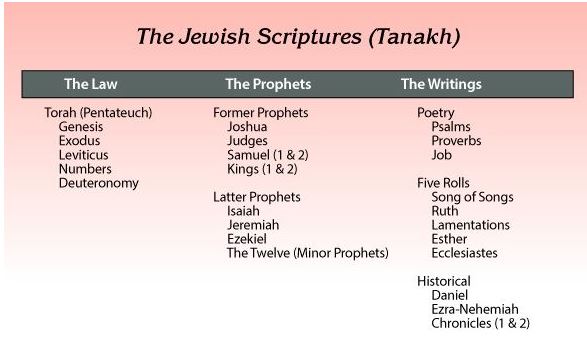
The reference to the “Psalms” is not merely the book of Psalms but the entirety of that unit of the Hebrew Old Testament. Jesus is telling us that the Proverbs teaches us of him.
But how and where? Where does it talk of the Messiah or some prophecy regarding Jesus?
Those were my questions a few years ago…until one morning when by God’s grace I had an “aha moment”.
The first and most visible place we see Christ, but not the only place, is in Proverbs 10:1-22:16. Here are some examples:
- 10:1, “A wise son makes a glad father, but a foolish son is a sorrow to his mother.”
- 10:4, “A slack hand causes poverty, but the hand of the diligent makes rich.”
- 11:5, “The righteousness of the blameless keeps his way straight, but the wicked falls by his own wickedness.”
- 12:5, “The thoughts of the righteous are just; the counsels of the wicked are deceitful.”
- 12:15, “The way of a fool is right in his own eyes, but a wise man listens to advice.”
- 12:19, “Truthful lips endure forever, but a lying tongue is but for a moment.”
With just this small sampling in mind let us consider: who is truly wise…diligent…blameless… righteous…wise and truthful? Who? Is it not the Son of God, our Savior and Friend? Here we begin to see how the Proverbs speak to us of Jesus. This book forms a type of biography on his moral character!
Proverbs 10:1-22:16 speaks consistently of the above mentioned moral characteristics. Therefore we ought to gaze upon the majesty of our Savior as we read each verse. In the Proverbs we are not merely being given teaching and application but we are also getting a further introduction to our Teacher.
2. Canonically-Ordered
As I mentioned above the Hebrew Old Testament (the TaNaKh) was ordered differently than our Old Testaments. Its order had a purpose. The Law was the foundation. We have the beginning, God’s promises, and God’s law. Then the books of the Prophets clarify and continue that content. God’s work, promises, and law are the foundation of what the prophets spoke. All that they preached to Israel and the surrounding nations was based on what God revealed from Genesis to Deuteronomy. They not only spoke to clarify what God’s law said, but spoke of the promised judgments that would arise from God’s law being broken (Deut. 28).
So the Law is the foundation. The Prophets build from the books of the Law. Then the Writings (i.e. the Psalms Jesus spoke of in Luke 24) give practical application for everyday life. Our view of the world is informed by the wisdom of these books. The book of Job teaches us of humility and suffering. The Proverbs give general insight to wisdom and how parents are to train their children. Ecclesiastes contrasts the temporal and eternal for a sharpened view on life. These books take both the instruction of the Torah and teaching of the Law, and give them feet. The teaching of the Proverbs was designed to guide parents in training their children according to God’s Torah…his law…his instruction.
Hear, my son, your father’s instruction, and forsake not your mother’s teaching…
Proverbs 1:8
What instruction…what teaching? Where are these coming from? Is this merely calling parents to pass on general morals and traditions…morals at their own discretion? No! The Hebrew parent would immediately have thought of Deuteronomy:
And these words that I command you today shall be on your heart. You shall teach them diligently to your children, and shall talk of them when you sit in your house, and when you walk by the way, and when you lie down, and when you rise. You shall bind them as a sign on your hand, and they shall be as frontlets between your eyes.
Deuteronomy 6:6-8
Deuteronomy 6 was a foundation stone of Jewish religion. So when they read from Proverbs 1 this would have come to mind, yet it would have come to mind quite often as the Hebrew parent read the Proverbs:
…bind them [commands] on your fingers; write them on the tablet of your heart.
Proverbs 7:3
When Solomon speaks of commands, teaching, and binding he is calling parents to instruct their children according to God’s law, especially the Ten Commandments. Yet, he also gives applicable and witty examples of what it looks like to live according to God’s law. This is the value of the Proverbs, leading us in obedience to our Heavenly Father.
Therefore, if one goes to the Proverbs, for personal or parental purpose, and looks at them as merely moral statements and guides we miss the meat of the book. The Proverbs are to be understood within the flow of the Old Testament. Thus we ought to be motivated on in our regular reading of the scripture: personal reading, group Bible study, and pastoral preaching. The more times through The Book we go, the fuller our appreciation of the Proverbs will become.

3. There is One Whole Book Devoted to this topic of Wisdom
If the Bible gives one whole book to a topic we ought to give heed. In a similar way I tell folks that the doctrine of the last resurrection is very important because Paul gives a whole chapter to it in 1 Corinthians 15. The same could be said for Christian love (1 Cor. 13), faith (Heb. 11), justification/forgiveness (Rom. 4), Repentance (2 Cor. 7), Creation (Gen. 1), and scripture (Psa. 119). Each of these doctrines are important as seen in an entire chapter being given to it, and it is to those chapters we ought to go to learn of these things.
How much more should we give attention and diligence to seeking out wisdom from a book that has entirely been devoted to the practice of wise living.
Closing Thoughts:
This book ought to be in front of us with frequency. Children need to be exposed to it from an early age. We see this to be so from the fact that it teaches of Christ, is the natural application of the Law of Moses, and it is a whole book devoted to this vital topic.
Recommended Resources: Proverbs by Charles Bridges & video devotionals by Paul Washer
 The Reforming Raker
Just finished a chapter-a-day study through Proverbs but after reading this, I hink I’ll do it again! Good one!
Love you! Mamaw
LikeLike