
Have you ever read a new book or watched a movie at the theatre the night it came out, and at the end thought: “That did not seem like the story actually ended.” Maybe there were questions left unanswered or plot-points left without a conclusion. When you set that book down or walk out of the theatre there is that unpleasant feeling of dissatisfaction. An unfinished story leaves our minds restless.
This should be the case when we read the end of Genesis 50. If you were a first time Bible reader and had never heard the stories of Exodus (burning bush, plagues, Red Sea, Ten Commandments) you would think that the author forgot something. Yet, The Author has not thoughtlessly and prematurely ended the story He planned. The Author of Genesis merely concluded that chapter before moving into chapter two: Exodus.
Intro
Here in a moment we will see how they connect…and how we learn of God’s work to glorify his name. Right now I want to quickly show how closely Genesis and Exodus are linked.
In the first chapter of Exodus we see two things connecting it back to Genesis:
- Edward Young notes, “The introductory word ‘And’ (in the Hebrew) connects Exodus with the preceding narrative of Genesis, and likewise the statement of 1: 1 presupposes the account of the entry into Egypt given in Genesis 46.
- Also, James Hamilton writes of the continuity of the two books as seen in the theme of “multiplying” (Gen. 1:28; 8:17; 9:1, 7; 17:6; 22:17; 26:22, 24; 28:3-4; 35:11; 47:27; 48:4, 16 AND Exo. 1:7, 12). In Genesis God commanded Adam and then Noah to “multiply”. Later He would bring a similar word to Abraham, Isaac, and Jacob but in the form of a covenant promise: “I will multiply you greatly.” The multiplication of Jacob’s family mentioned in Exodus 1:7 provides continuity from the Genesis narrative on into the account of the Exodus.
God’s Glory
Last time we saw how the fundamental teaching of the Bible about salvation can be found in seed form in Genesis. They are seeds in Genesis which grow and develop as the Bible unfolds. There is one final point for us to look at, one which I believe can be found within the book of Genesis, yet I believe we see it clearer in Exodus. And as I have shown above, Genesis flows right into Exodus so that there truly is one narrative.
We should begin by asking: What is the purpose of the book of Exodus?
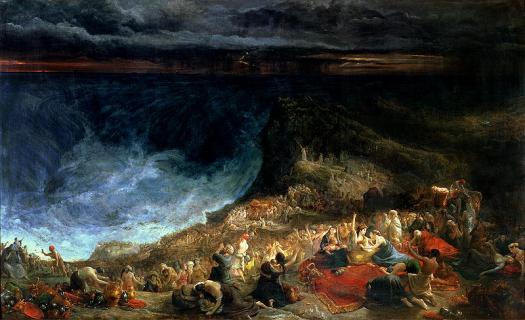
James Hamilton, as mentioned above, might say that Exodus was written to demonstrate God’s glorifying Himself in salvation through judgement. Meaning…God brought glory to His name as He judged Egypt by plagues and thus led His people out. Later at the Red Sea God displays His greatness by saving His people through the waters of the Red Sea while the same waters were used for judgement on Egypt.
The plagues and the Red Sea are but a few examples amid many others in which the purpose of Exodus is seen. Above we looked at Hamilton’s observation that God bringing glory to His name, or we could say: God is making His greatness known. See it from Exodus:
- “This is what the LORD says: ‘By this you [Pharoah] will know that I am the LORD: With the staff that is in my hand I will strike the water of the Nile, and it will be changed into blood.”(7:17)
- Moses said, “Be it as you say, so that you may know that there is no one like the LORD our God.” (8:10)
As the book progresses we see that God is moving so that He is known not only to Pharaoh by His greatness but also throughout Egypt and even unto the ends of the earth (Exo. (:14-16). God is making His greatness known by judging the wicked and saving His covenant people.
History: God’s Great Parable
Later in scripture, in many and various places, we see the events of the exodus used as examples of God’s work to redeem a people from slavery to sin. Not only is the redemption of Israel a pattern and parable of God’s work to save the soul, but also the overarching purpose: God’s glory. We could spend a series of posts examining various places we see this explained, but for brevity’s sake I point us to Revelation 7. So grab a Bible and read Revelation 7:9-17.
Revelation 6&7 pictures God’s judgement on the wicked while saving His people. John wants to
- a) put forward to his audience an unseen reality;
- b) for their sobriety of mind and for hope;
- c) In this he uses imagery from Exodus 12 and 15 to help demonstrate God’s mercy being worshipped.

This use of Exodus is no anomaly for John. He regularly uses concepts and stories from Exodus to assist him in conveying what he sees in his vision. In Revelation 7:9-17 we see:
- “A great multitude…from every nation coming out of tribulation” (7:9, 14; Exo. 12:38). John uses imagery similar to that of the exodus event to give his readers a tangible idea of what God’s salvific deliverance looks like…history as a parable. Just as a multi-ethnic group came from Egypt (Exodus. 12:38) by the power and mercy of God, so our salvation is by that great mercy. It is God’s powerful kindness that will carry us through this life and on to the New Jerusalem.
- “They have washed their robes and made them white in the blood of the Lamb.” (7:14; Exo. 12:13). This detail may seem a stretch at first, yet as we continue to see all the various parallels of Revelation 7:9-17 with Exodus 12 & 15 I think you will see that there is indeed a tie between the two. For now let us see how it is the blood of the Lamb that sets God’s people apart. In Egypt it was the blood of a year-old lamb spread on a door. In Revelation 7 we read of The Blood shed on a Roman cross, a sacrifice acceptable and pleasing to God on behalf of the people of God by the Son of God. The people of God are not inherently more attractive to God by something of their own, for it is by the bloody sacrifice of Jesus that our guilt is washed away so that we are welcomed by God. It is God’s mercy that brings us in by the cross into His merciful presence.
- “Salvation belongs to our God…” (7:10-12; Exo. 15:2). John shows us how God works out salvation for His people so as to be worshipped (7:12). This whole theme is seen in various places and in various ways throughout the Bible (Exodus 15; 2 Samuel 22, the psalms, Romans 11:33-36, and Revelation 7). God purposes that his people would see Him in His wonder and majesty so that our minds would be mesmerized. By His great work He intends that our hearts run over with joy as we see clearer and fuller pictures of His glorious grace. His worship is yet for His honor but also our happiness. There is no happier state of being than pure worship of God upon catching a greater glimpse of the One who is higher than I.
These are but three examples of the correlation between Exodus and Revelation. Allow me to list off the others in brief and then give some closing thoughts.
- “They…serve Him day and night in his temple; and he…will shelter them with His presence [tabernacle]” (7:15). Not much further into the Exodus story the tabernacle is built so that God could dwell with and shelter his people (Exodus. 35-40).
- “They shall hunger no more, neither thirst anymore…” (7:16). Immediately after the crossing of the Red Sea God provides water and food for His people supernaturally. This historical event exemplifies how God cares for his people in totality: body, mind, and soul (Exodus. 15:22-16::36).
Conclusion
God works to redeem his people according to the counsel of His will for the honor of His name and true happiness of His people. This is displayed for us in the historical narrative of the exodus with realistic examples. Yet, as we have seen, the apostle John by using this Old Testament story shows us with further clarity how God works for his peoples good even today. however, the good worked for all of God’s people by The Blood of the Lamb is no temporal blessing, but everlasting. God will be praise by His people enjoying paradise in the end, as we read in Revelation:
For the Lamb in the midst of the throne will be their shepherd,
and he will guide them to springs of living water,
and God will wipe away every tear from their eyes.
Revelation 7:17 (see 21:4, 6; 22:1, 17)
Let us not wait until that day to seek the Shepherd. The Lord is thy Sheered, ye shall not want. Seek his face; seek living water for your soul that is found with the Shepherd. Tell Him of your sorrows and fears, and receive peace that surpasses understanding.
 The Reforming Raker