

Have you ever had to rethink…reevaluate…and remove something? That moment where you start to study and learn and realize you were wrong? Maybe it was an assumption about a friend. I remember a young man I was in Sunday school with and thought he was an absolute jerk. As I got to know him over the next several years I saw that he was a really great guy.
Have you ever been reading your Bible or studying with a group, and you have a light bulb moment? Sometimes we assume we understand something but upon further investigation we need to rethink…reevaluate…and remove something from our thinking.
This post is my journey through Mark 13:24-27 in preparation for preaching at church. It has been a process of some months now coming to a head. I ask two things: 1) an open mind. 2) feedback. I would love to have discussion in the comments on this whether you agree or disagree. May that be for mutual encouragement, but I also ask so that I might better think through this text.

Here below I will argue that Mark 13:24-27 is speaking of the final stage of transition from old covenant age of Israel to the New Covenant age of the Church with the events of 70AD. I believe this is a more natural progression within Mark as well as the Olivet Discourse. This fits Mark’s flow of narrative as well as his sourcing coming primarily from Isaiah. These verses borrow heavily from Isaiah. With that I will seek to make sense of these four verses by considering the information of:
- a) Mark 11:1-13:23
- b) Mark as a whole
- c) Mark’s regular use of Isaiah.
Mark 13:24-25
But in those days, after that tribulation. “
Mark 13:24a
Jesus spoke of both the preceding and actual events of 70 AD in 13:5-23. The terms are that which describe difficulty and tribulation. Now Jesus comments on the occurances which follow.
“… the sun will be darkened, the moon will not give its light, and the stars will be falling from heaven, and the powers of the heavens will be shaken.”
Mark 13:24b-25
What are we to do so as to process these cosmic terms?
Is this referring to the real sun, moon, and stars?
I would argue no. Jesus says later in Mark 13
Truly, I say to you, this generation will not pass away until all these things take place.
Mark 13:30
What ever Jesus was talking about in Mark 13:24-25 occurred prior to the passing away of the generation to whom Jesus spoke. So because the sun and moon are still in the sky now, Jesus must be speaking of something else.
I propose that Jesus is using a prophetic term that his disciples would have been familiar with. The term comes from Isaiah. Here is why I believe Jesus is using ideas from Isaiah.
Mark’s use of Isaiah’s Teaching
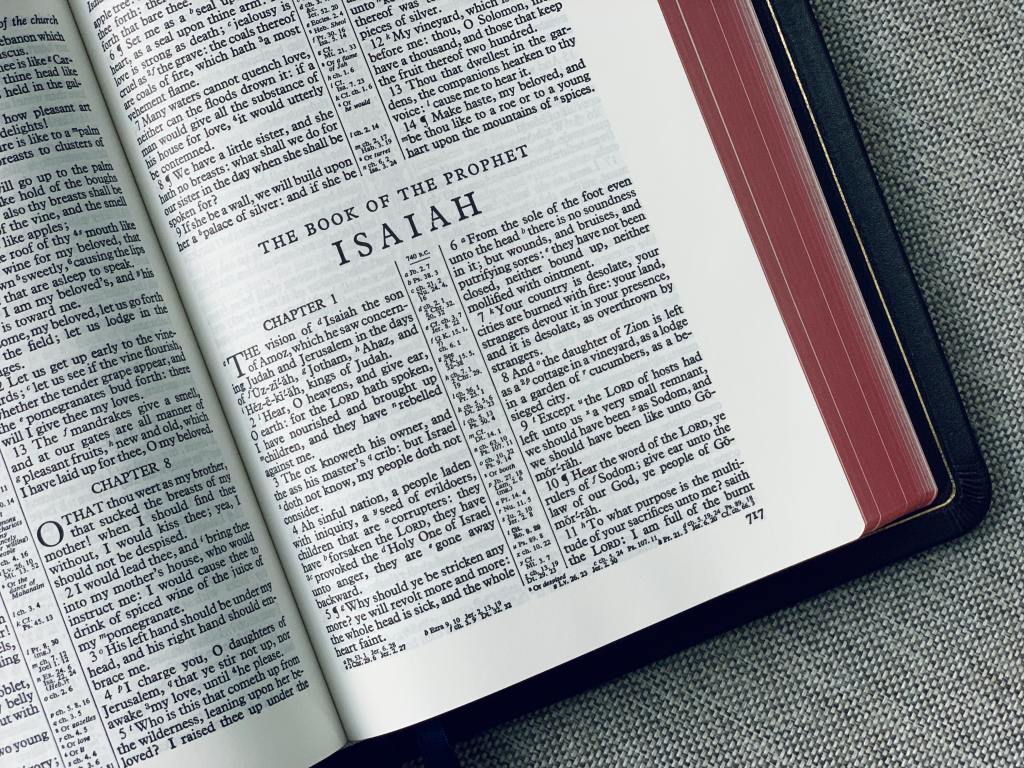
Mark has been drawing from Isaiah from the beginning. Mark’s opening words (1:1-2) quote from Isaiah 40:3.
“A voice cries: “In the wilderness prepare the way of the LORD; make straight in the desert a highway for our God.
As it is written in Isaiah the prophet, Behold, I send my messenger before your face, who will prepare your way, the voice of one crying in the wilderness: ‘Prepare the way of the Lord, make his paths straight,’”
Isaiah 40:3; Mark 1:2-3
Mark’s book explains how God’s promises come about by Jesus.
With that, and more to our point, we have previously seen Jesus use language of judgement from Isaiah (Mark 7:6; 11:17). So here in 13: 24-25 we have language quite similar to Isaiah 13:9-10. As with Mark 7: 6 & 11:17 let us seek to allow Isaiah’s meaning to inform our understanding of Mark 13:24-25.
In Isaiah 13 we read of God’s judgement on Babylon.
“Behold, the day of the LORD comes, cruel, with wrath and fierce anger, to make the land a desolation and to destroy its sinners from it. For the stars of the heavens and their constellations will not give their light; the sun will be dark at its rising, and the moon will not shed its light.”
Isaiah 13:9-10
Judgement on Babylon will be severe to the point of its complete ruin and end. That is what is meant by the darkening of the stars, sun, and moon. When God’s judgement fell on Babylon to ruin and undo it, it was likened to a dark moon and sun. For the sun and moon to be dark is for them to exist no more. This sort of talk by both Isaiah and Jesus is typical of prophets. It is extreme language to show how serious God’s judgement is. Let’s see two other examples. Jesus said in 13:2 that not one stone of the great temple buildings would be left “one stone upon another” yet even today stones are still stacked in Jerusalem. Was Jesus wrong or using extreme language? It was the latter. So he does in 13:24-25.
Another example, noted by Rikki Watts, is Isaiah 34: 9 where similar judgement is spoken against Edom, who like Babylon attacked God’s people Israel. There we read,
And the streams of Edom shall be turned into pitch, and her soil into sulfur; her land shall become burning pitch.
Isaiah 34:9
Can we reasonably say that their water turned to pitch (or tar), and their soil to suffer? Or is it more likely that this is similar to 13:9-10 where extreme language, hyperbole, is used? It is more likely that 34:9 speaks of nature being ruined and undone as a sobering symbol of the judgement to come. Edom, like Babylon, would be completely ruined.
We see how Jesus and Mark draw from Isaiah (Mark 1:1-2; 7:6; 13:24-25), and we see how Isaiah’s meaning helps us understand the phrases in Mark. Therefore, Jesus, in 13:24-25 is speaking of the complete end and ruin of the nation of Israel as it had previously been known. The whole talk of Mark 13 has been about the end of the Old Covenant Age of the Jews. Here Jesus is making the final point. The judgement to come upon that generation of people in 70AD (13:30) would be the end of one age and the beginning of another.
Think about Mark 13:24-25 in Light of Mark 11, 12, & 13
Very quickly before we move on let us see this understanding of Mark 13 in the flow of Mark 11, 12, & 13. In Mark 11:12-14 Jesus curses the fig tree because it had no fruit. That story, or what we might call a living parable, especially when connected to the story which directly follows, symbolizes Jesus’ judgement against the temple city of Jerusalem. Jesus spoke saying, “May no one ever eat fruit from you again.” He was using the biblical symbol for Israel, a fig tree, so pronounce judgement on Israel.
These words come at the beginning of Mark 11-13 which is one uniting Mark. Therefore, we must understand Mark 13 in light of the context of Mark 11, 12, & 13.
Right after the teaching regarding the fig tree he enters the temple, clears out the rebels, and says, “My house shall be a house of prayer but you have made it a den of thieves.” That last part about the thieves is a quote from Jeremiah who preached in the temple (Jer. 7). He preached a message to call Israel’s leaders to repent or be destroyed. By Jesus quoting Jeremiah’s words we are meant to understand Jesus’ words to carry the same intended meaning.

This feel and language of judgement carries through the rest of the narrative. Here in Mark 13:24-27 we must remember the context of these four verses. It is the honoring of the context that will give us a smoother path to follow unto a firmer grasp of the text’s meaning.
With that said let us look to the final two verses where we read of the beginning of the next age that is spoken of by Jesus in 13:26 (Lane; Watts; Gill).
Mark 13:26-27
“And they will see the Son of Man coming in the clouds with power and glory.”
Mark 13:26
Question. What will be seen? We may be quick to say Jesus. That is, Jesus in physical form coming from heaven? Here, once again we need to ask the question: Is this language of 13:26 found elsewhere in the Bible? If so how is it used and what is meant by it?
We find it in Daniel 7:13-14. The description in both Daniel and Mark is of One who has received a Kingdom, and is reigning over it.
“I saw in the night visions, and behold, with the clouds of heaven there came one like a son of man, and he came to the Ancient of Days and was presented before him. And to him was given dominion and glory and a kingdom, that all peoples, nations, and languages should serve him; his dominion is an everlasting dominion, which shall not pass away, and his kingdom one that shall not be destroyed”
Daniel 7:13-14
What is seen is the coming Kingdom. If we only think Mark wants us to understand this as humanity seeing Jesus return in body, then we miss the rest of the verse. In other words the sight will be that of what Daniel saw in Dan. 7:13-14. The Son of Man, Jesus, will have possession of his reign as king, and his dominion and glory will be both seen and felt through all the world. And its formal starting point was 70 A.D. Why 70 A.D.?
Because it had to happen before that generation died.
Truly, I say to you, this generation will not pass away until all these things take place.
Mark 13:30
But also we remember Jesus’ earlier words,
“And he said to them, “Truly, I say to you, there are some standing here who will not taste death until they see the kingdom of God after it has come with power.”
Mark 9:1
That verse sounds like 13:26 and 13:30 put together. The power and glory of the Kingdom was both felt and seen in the stories of the book of Acts. If one wishes for biblical proof that the Kingdom came in power and glory, though not fully, in that generation, read Acts.
For one more text that shows the nearness of the coming Son of Man on the clouds let us look to the next chapter.
“Again the high priest asked him, “Are you the Christ, the Son of the Blessed?” And Jesus said, “I am, and you will see the Son of Man seated at the right hand of Power, and coming with the clouds of heaven.”
Mark 14:61-62

Here, Jesus speaks in similar fashion as to his disciples. He speaks directly to the Sanhedrin before him: “You will see…” The event, which appears to be identical to the one of Mark 13:26, is said to be seen by those who are before Jesus in 14:61-62. This event was much closer to the day of the disciples and Sanhedrin than it is to our day.
Finally we read of Jesus’ power at work to bring in people from every nation and culture from around the world.
And then he will send out the angels and gather his elect from the four winds, from the ends of the earth to the ends of heaven.
Mark 13:27
As with the previous verses we need to see if we might learn from scripture elsewhere. What can we know from the context and other scripture which might help us to understand this text.
Once again the Old Testament prophets helps us to understand what is occurring here. Namely, we learn from a variety of passages that a part of the Messiah’s ministry would be to gather the people of God (Isaiah 2:2-3; 56:7). This gathering by Christ, and the unseen ministry of the angels, is the divine activity of the New Testament (i.e. A.D.) age.
With the temple destruction, the last remnants of the Jewish Old Covenant Age has been formally undone and removed (13:24-25). Now Jesus moves to gather all the children of Abraham, Jew and Gentile, from the nations under heaven. The destruction of the stone temple was in conjunction with the establishing of the New Covenant Temple (2 Cor. 6:16; 1 Pet. 2:4-8). Jesus is building his temple, the Church from Jew and Gentile.
Closing Thoughts
So we, the stones of this temple, have a sure future. Our King is building. He has his angels at work. His kingdom will advance and develop unto the end God intends it for.
We may live in joy that we need not travel one location to worship, but we may worship anywhere in this world. Churches can be established anywhere for the members of that church are the temple. God is there. He is no longer dwelling in a singular location but with his Jew/Gentile people around the world.
Yet let us take warning. Let us check our own hearts for such rebellion as brought condemnation on Jerusalem. What rebellion is in our hearts? When did you last pray for God to reveal rebellion in your heart? Rebellion against God was the great undoing of Israel. Let us be on guard against the ways we reject the ways of God.
 The Reforming Raker
Context is so critical to understanding scripture. Good reminder to check our own hearts for rebellion. We don’t recognize it unless we really look at it. Another good one!
Love you Mamaw
On Sat, Aug 21, 2021 at 3:19 PM The Reforming Raker wrote:
> Pastor_M. posted: ” Have you ever had to rethink…reevaluate…and remove > something? That moment where you start to study and learn and realize you > were wrong? Maybe it was an assumption about a friend. I remember a young > man I was in Sunday school with and thought he was ” >
LikeLiked by 1 person
Thank you. I did not plan to go this route until I was working on my sermon. Some lightbulbs went on in my thinking so I decided to turn it to a blog. Yes, context is critical.
LikeLiked by 1 person