

I have always had a mentality that could be expressed in the childhood phrase: “says who??” Those are two classic words of a young child trying to determine the authority behind the instructions given them. Now this certainly got me into trouble… and still does. Yet just the same, from little kids to adults they want to know who is right…. or at least they should want to know.
So then who is right in various theological discussions and debates? How can we know who to listen to and which side to agree with? Below I want to share a few thoughts with you on that issue with hopes of helping you think through topics we have already seen regarding the doctrines of salvation as well as others that we will explore in the future. Please consider the following:
Table of Content
- Bias or Theological Conclusion
- Bias or Logical Conclusion
- Who is Consistent and Coherent
Bias or Theological Conclusion?
It is inescapable that we each have biases in all parts of life that have been shaped by past experiences. One of my personal and favorite biases is the fact that I have the cutest and most pleasant 5-month-old of all time. My experience has shaped how I see babies, for good or bad.
Now we enter the realm of bible study and this accusation often arises in controversial texts like the ones we have been discussing on God’s amazing grace to save. It is easy for one brother to accuse another that his conclusion is founded on bias. In other words: “You are not accepting what that passage really says because you have a bias about this area of theology and you are trying to make this passage fit.”
The effect of bias on Bible study does indeed happen. I have done it and still catch myself doing it. It often happens when we go to a passage of scripture looking for a specific truth instead of going to a passage to receive whatever truth might be revealed. We must avoid this. However, there are times when we do something that may look similar but it’s very different. Not only is it different but it is a healthy way to study the Bible.
Before we discuss that different practice let me give a word of caution. If you say to yourself: “I have no biases. I just read the Bible and believe what it says.” If that is you do be careful. To put it in the words of James White (Pastor & Apologist), “Those who say they have no biases are in the worst of places for they have the most and don’t even know it.”
Now let’s discuss how we can understand a passage based on things outside of that passage but not outside of scripture.
When we encounter a difficult or unclear passage we should use other passages which are more straight forward to clarify the difficult texts. As an example I will point to a discussion we will have in the next major topic of theology: End Times Theology or Eschatology. In that study there is difference of opinion regarding how this world will conclude: Will it be destroyed entirely so that an entirely new earth can be created or is this earth going to be greatly renewed? Here is the tension in short:
- Based on the following text from 2 Peter people believe the earth will be destroyed entirely in the end: “But the day of the Lord will come like a thief, and then the heavens will pass away with a roar, and the heavenly bodies will be burned up and dissolved, and the earth and the works that are done on it will be exposed.” – 2 Peter 3:10
- Then there are various themes of scripture and passages that speak of creation being glorified and changed forever, and forever free of corruption (Romans 8:20-23; Revelation 20:5)
- If our study was on 2 Peter 3:10 a part of that study would need to be making sure we have not contradicted other passages in our conclusion.
- To conclude that the earth will get blasted like Star Wars would be to clearly contradict Romans 8 and Revelation 20. The clarity of those chapters and the many others that support it should be utilized in our theology as we work through 2 Peter 3.
- With that said it is perfectly reasonable and respectful to appeal to clearer passages to help us understand the harder ones.
- Finally, if you wonder why I would suggest that the earth will be made new instead of destroyed stay tuned for the posts on End Times beginning in early August.
Therefore, when you read passages about God’s choosing individuals to whom he would show mercy, the substitutionary atonement of Christ for God’s chosen people, and the Spirit’s work to call out to the soul and heart of this people (as we will see next week), remember to let the clearer passages help you understand the harder ones. Scripture interpreting scripture is not yielding to a bias while studying but yielding to the Word of God as the authority.

Bias or Logical Conclusion?
Every day we take two or more facts and after putting them together make a conclusion. This can happen in many ways:
- All college students read books. Phil is a college student. Therefore Phil reads books.
- All missionaries to England fly by airplane. The only airport in England is in London. Tim is going to England as a missionary. What will be his first stop in England? He will stop first in London, England.
I press the point on logical conclusions because that is a huge part of how parts of Christian doctrine have been established. A prime example of this is the doctrine of the Trinity, and that Jesus is fully God and man. You will find no verse that spells that out plainly (1 John 5:7 will be discussed at another time). In this case we utilize logic to take several truth claims and put them together to conclude the doctrine of the trinity and that Jesus is God in human flesh (truly God and truly Man).
With all of that said we find this line of thought used at times in thinking through how God has worked. It is important to know that in general but also when someone says: “If the Bible does not say it then I do not believe it.” Remember, the Bible no where uses the word trinity nor does a single passage lay out the truth explicitly unto itself. This is good news because that allows us to build doctrine on passages instead of “silver bullet” verses.
The other reason I mention it is to clarify my method of working through these passages, and the ones to come. In the not so distant future we will explore how our understanding of God impacts our belief about how he accomplished salvation. Remember that the Bible is one book by one God. It is not illogical to think that by gleaning from several passages that one might discover truth which is not concisely spelled out in a single verse (i.e. the Trinity).
Below is what I call the Owen Bomb. It is a prime example of using logical thinking in our study:
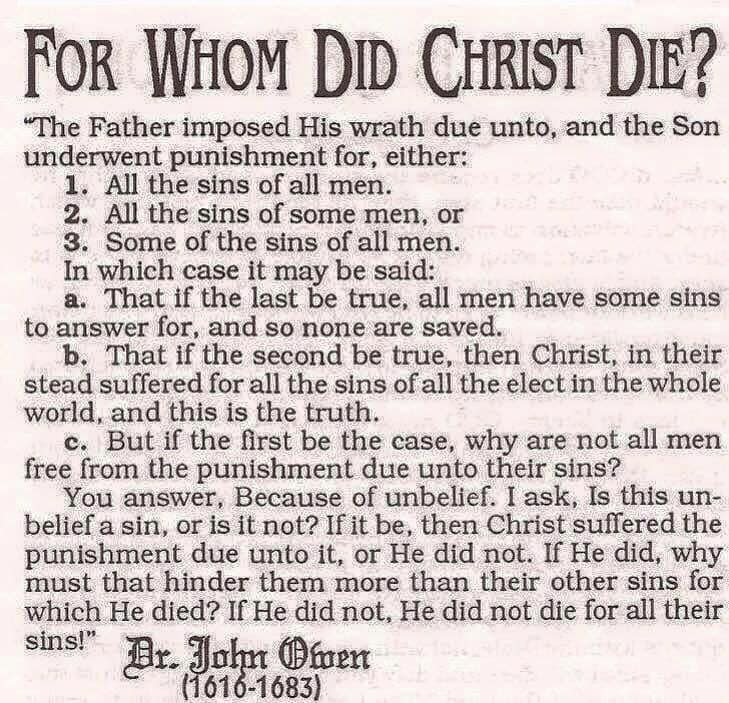
Owen shows us what it looks like to take observations from scripture and reach a logical conclusion.
Who is Consistent and Coherent?
Imagine a construction crew that builds houses. If they do not build the same parts of the house the same way every time they build (consistency), and do so in a way that displays unity between the foundation, walls, and roof (coherence) they will have low productivity or accomplish nothing. If walls are constructed differently each time and the various parts of the house constructed in different order from house-to-house there will be inconsistency and incoherence. That construction crew will not be dependable and may cause both damage and danger.
When there is no consistency and coherence to our study of the Bible we do damage to our understanding of the word and there by putting our soul in danger. So how do we abide by this idea as we listen to various positions as to how we should understand different teachings in the Bible?
- Who is referencing scripture? This may seem like a simple, or too simple, an answer however it is where we must start. There are plenty of people making arguments out there that reference no scripture. If the argument is not obviously connected to the Bible it caries no weight.
- Who is handling the scripture well? There are those who go beyond the person who mentions no scripture, but they only reference parts of scripture which assist in what they want to communicate. A person who is handling the Bible well is the person who opens up the pages of God’s word and explains what they mean. A good example of this which accords with my recent posts is a debate on Romans 9 you can find on youtube between James White and Leighton Flowers. To save time I would recommend listening to 4:30-25:30 & 38:30-59:00. I will leave you with this question as you listen to it: Which man shows consistency and coherence in explaining Romans 9?
- Who is using passages instead of verses? As noted above and in previous posts, doctrines are built on passages of scripture (large chunks of scripture) not a verse here and a verse there. When you hear two or three or four different opinions about a particular doctrine be sure to note who is systematically explaining the doctrine from a passage instead of saying I believe this…and here is a verse to prove it.
- Who is be consistent and coherent? Is the person you are listening to explaining the doctrine in the same way he would explain the Trinity or Divinity of Jesus? Is the doctrine understood based on what is being read from the passage or is the doctrine coming from what someone is reading into the passage? Just as with the Trinity and Divinity of Jesus we take what various passages teach and from that conclude what is true, while ensuring it is in accord with the whole of scripture, so we do the same with any doctrine.
Conclusion
Just because someone has studied the Bible at university or graduated from seminary does not mean they cannot be questioned by someone who has not had this training. Not only can they be challenged but you have the right and ability to do so. You are created by God and given a mind and intellect. You have the ability to reason as an image bearer of God. The doctrines which are often discussed too much in the classroom and not enough in the church can be sought out and benefited from any child of God who chooses to pursue it.
PS – Resources
I thought this would be an appropriate place to place this article which points out five excellent free online resources. I hope it is helpful. Also on the topic of logic and the study of scripture see here by John Frame.
Two Applications
- Love the Lord your God with all your mind. The greatest commandment of the scriptures includes the command to love God with your mind. That is to say that when you put forward mental effort to understand and reasonably approach the scriptures you are loving your God. In a similar way as a young man puts effort into trying to understand that young lady he has been captivated by so also when we pursue understanding of this God who has captivated us with his love it is acting out in love toward him. It is loving him because he first loved us. Going to your Bible with pen and paper is a way of loving God. Going on the internet or Bible study to better understand our heavenly Father and his ways his an act of love and worship toward him. Go to the Bible and love the Lord your God with all your mind.
- You have all the Help you will need. Several years ago I was in Honduras on a mission trip. A local pastor was leading a Bible study in which he taught us that we are more blessed than Moses. Moses experienced the presence of God at the burning bush. The pastor explained that Moses would be jealous of New testament believers because we don’t experience God at a bush but instead the Spirit of God burns within us. My brother or sister you have the very presence of God in you, teaching and guiding you into all truth (John 16:13). As you go to the Bible with pen and paper ask Him to Help you understand the Word. As you come to difficult passages ask him to give you understanding.
“Ten minutes in prayer is worth more than any commentary.”
George Whitefield
 The Reforming Raker
Wow. Sean thank you so much for sharing this article. Knowing, studying, and sharing Scripture is so important.
LikeLike
It is important to study the Bible well. It’s truth leads us to joy. This is a subject I have come to feel strongly about in the last few years.
LikeLike
Another good one! Love you!
On Mon, Jul 13, 2020 at 4:53 PM The Reforming Raker wrote:
> Pastor_M. posted: ” Photo by marianne boson Unsplash I have always had a > mentality that could be expressed in the childhood phrase: “says who??” > Those are two classic words of a young child trying to determine the > authority behind the instructions given them. Now this ce” >
LikeLike
Thank you. I was able to write it on vacation.
LikeLike