
Before I was married or even knew who Hannah was I began to write letters to my future wife. I would write these letters on holidays like Christmas or when I would travel. In the moment it was a way for me to share the moment with my future bride although she was not present. I would talk about the day or events happening on the trip. Obviously all of this was stated in a general sense because I did not know her yet. Any expression of desire to get to know her was vague because we had never met and knew nothing of each other. However, once we met, dated, and married those letters continued and became more personalized to Hannah for who she is. I can encourage and admire her in writing in a way that was impossible 10-years-ago.
Is that how we think about the love of Jesus to us? Do we consider it to be this general expression of love as seen at the cross that one day would become personal once we believe? I like to think that for Jesus it was always specific and personal (see blog post on Rom. 8:29). Let us consider his words in John 15:
“Greater love has no one than this, that someone lay down his life for his friends. You are my friends if you do what I command you. No longer do I call you servants, for the servant does not know what his master is doing; but I have called you friends, for all that I have heard from my Father I have made known to you.”
John 15:13-15
In the context of this passage (John 14-17) Jesus is explaining to his disciples who they are in light of his work done to them. Here he is expressing to them their identity as his friends. The expression about the greatest love easily connects with Jesus’ own death because the context not only explains who the disciples are but what is about to happen: death and ascension. In short Jesus is telling his friends that he will express the greatest love by dying for them. This is specific and personal. Jesus did not die just incase they decided to welcome his friendship.

With that in mind we will once again revisit the concept of Jesus dying as a substitute (on our behalf) to make atonement We will see how Jesus’ atonement as foretold in Isaiah 53 is elsewhere spoken of in the New Testament.
The Substitute of Isaiah 53 clarified in the New Testament
John Gill, an English pastor of the 1700’s, points out in his commentary on 2 Corinthians 5:14 how the phrase “died for” in the New Testament is short hand for substitute. He goes on to note how as “substitute” he is the sacrifice, ransom, and propitiation.
What passages are these that Gill refers to? Obviously they are numerous for every epistle of Paul, Peter, John, James, and Jude explain to us the redemptive work of Jesus as the Substitute. But here are a few to point out for us:
- Hebrews 7:26-28 (sacrifice)
- Revelation 5:9 (ransom)
- Romans 3:25 (propitiation)
Hebrews 7:26-28 and Sacrifice
For the sake of space this section must be “limited” (pun intended) however for further reading I would encourage you to read 7:11-10:18. Pay attention to the various teaching on sacrifice and priesthood. Those chapters beneficial to read for understanding Jesus’ sacrifice. If you are feeling really zealous go read Leviticus 1-7 & 16 then go read Hebrews 7:11-10:18.
Now to the verses at hand.
“For it was indeed fitting that we should have such a high priest, holy, innocent, unstained, separated from sinners, and exalted above the heavens. He has no need, like those high priests, to offer sacrifices daily, first for his own sins and then for those of the people, since he did this once for all when he offered up himself. For the law appoints men in their weakness as high priests, but the word of the oath, which came later than the law, appoints a Son who has been made perfect forever.”
Hebrews 7:26-28
- Notice the words holy, innocent, unstained. What we find of Jesus in the book of Hebrews is that he is not only The Sacrifice but also The High Priest. Both of these Old Testament functions find their fullness and end in Christ. He majestically embodies both.
- As the sinless priest and unstained sacrificial Lamb he made this sacrifice “once for all when he offered up himself.” This is a sacrifice which contrasts the Old Testament sacrifices in that it is far greater. Its greatness is seen in its effect. The Old Testament sacrifices (Lev. 16) were effective for all for whom they were made for the covering of sin until the Messiah should come. The Messiah’s sacrifice was greater in that it was not an annual offering up of blood but one offering once for all time finished. It was not a sacrifice that had potential but effect. Just as the Old Testament offerings had a smaller effect and not just a possible effect, so also this greater sacrifice was one of effect.
- This passage and the others commended above from Hebrews show us a particular surface of the beautiful diamond of Christ’s substitutionary death for the people.
Revelation 5:9-10 and Ransom
This is such wonderful verse because it brings “theology” and worship together.
“And they sang a new song, saying, “Worthy are you to take the scroll and to open its seals, for you were slain, and by your blood you ransomed people for God from every tribe and language and people and nation…and you have made them a kingdom and priests to our God, and they shall reign on the earth.”
Revelation 5:9-10

- Our worship can only be true worship when it is rooted in the work or character of God. Here we find this in the heavenly vision as the Lamb is worshipped for the very thing we just saw in Hebrews 7.
- This mention of Jesus as the Substitute adds the dynamic of “ransom”. In plain terms a ransom comes into a situation when someone is in danger by another. The ransom is a price of some sort payed to the one by whom danger will come. This is how it is laid out biblically: The Redeemed are ransomed by Son (Rev. 5:9) from the wrath of God unto the mercy of God. It is a work done by the Trinitarian God. We are not only criminals but also debtors to God. Our debt is infinite for our sin is against an infinitely holy God who has revealed himself in his law, the law that we break. We are debtors to his court. The Lamb, by substitutionary atonement, ransoms us from the criminal debt we owe. For that he is to be worshipped indeed.
- Although the question: For Whom Did Jesus Die? is often thought to narrow the sacrificial work of Jesus (or “limit” it) we see here that is not the case. I argued in the first post on “TULIP” how I dislike, as do many, the term “limited atonement”. The phrase “definite atonement” or “particular redemption” better represents the scriptures teaching on the mission of Jesus to be the substitute sacrifice. The ransom paid was for people from “every tribe and language and people and nation (ethnicity).” That is a poetic way of John writing out that Jesus died for kinds of people, small and great, from all over the world. People from the highest mountain and furtherest island are in view here. They were ransomed.
- Final thought: In good conscience can you say that this is true of all people for all time? This question must be asked because the ransom results in the redeemed reigning. If Jesus died for every soul, every person who has lived in this world then we must conclude that they all (Nero to Hitler) will be apart of this kingdom and priesthood. A reigning with Christ as kings and priests is one result of the Lamb being slain.
Romans 3:24b-25a and Propitiation
“…through the redemption that is in Christ Jesus, whom God put forward as a propitiation by his blood, to be received by faith.”
Romans 3:24b-25a
The concept behind the word propitiation could be likened to the following. Imagine a a dry sponge. It is so dry that it has become rock hard. What happens when you drop it into a bowl of water? Instantly it soaks up the water. It becomes saturated and filled.
We can take this idea to the cross where we see redemption by Christ “whom God put forward as a propitiation by his blood…” Jesus in that moment was a dry sponge of guilt, sin, and grief. The cup containing the tempestuous waters of the holy, righteous wrath of God was poured out over him. In this moment he was the sole object of the righteous judgement of God. He soaked it up until there was no more. A propitiation leaves no residue. He absorbed all the wrath and punishment needed.
Again we have a problem in seeing this as being done for all people. If he made this sacrifice for all, then why are there those who go to hell? If all sin and guilt has been fully death with in Christ at the cross then hell is no longer needed. Yet we see plain teaching in scripture that there will be those who go there after death. As we think about this I will not try to reinvent the wheel but share a helpful thought from John Owen:
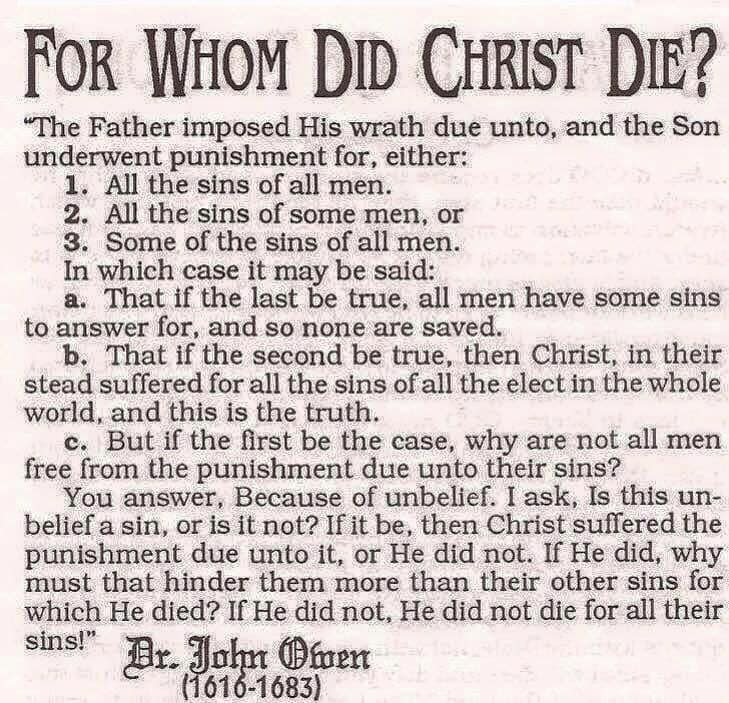
Consider what has been put forward by Owen. It is not put forward as a man-made argument but a summary of a biblical argument laid out by a man. I hope it provokes further thought on this topic of Christ’s sacrifice.
Conclusion
In the unfolding of scripture Isaiah 53 is one of the clearest prophecies of the death and sacrifice of the Messiah. It was a sacrificial work for a particular purpose and people. This Messiah’s work is further explained by by the apostles of the New Testament. As we follow the teaching laid out for us by the apostles as they clarify the prophetic writings we see a personal love from the Triune God at work for his people.
Two Applications
The God of the Bible: We will see in blog posts of the not so far off future how our belief in who God is heavily impacts how we understand the Bible. It may be said that our understanding of the character of God are the glasses by which we read the Bible. Ones conclusion about what Jesus purposed and achieved in his death begins with how we understand the Triune God. My challenge to you is to pick a book of the Bible and read through it in this method:
- Circle every occurrence of the name of God (God , Lord, Jesus, Christ, Spirit, etc.).
- Underline what he does or says.
- Take brief notes on what you learn about the Father, Son, and Holy Spirit.
This has been one of the most beneficial exercises I have ever done in my Bible. I went from Genesis to Deuteronomy, books that I had previously found boring. This method brought them to life. It was like reading God’s autobiography.
Justified: I remember a difficult season back in my brief college days. In that time I often found comfort in the reminder that I was justified. When we remind ourselves that we are righteous before God and consider the implications: eternal hope, everlasting future, and the blessings of God on us for ages upon ages. When these things are considered nothing can dampen that joy. Suffering may continue but that reality of justification will make us endure.
 The Reforming Raker